CONSTITUTION
ECONOMY
EDUCATION
ETHOS
FOREIGN POLICY
WOMEN
MARRIAGE
SEXUALITY
ART
LEONIDAS
ESSAYS
NOVELS
SOURCES
SCREEN SAVER
GUEST BOOK
AUTHOR BIO
SPARTA BLOG
AUTHOR WEBSITE
SPARTAN THEMED
T-SHIRTS, TOTES
& MORE
RESOURCES AND TIPS FOR FURTHER RESEARCH AND READING SOURCES:
Ancient Historical Sources
A number of works by ancient historians are readily available to us today in translation. For anyone with a serious interest in ancient history, these works are a "must." However, keep in mind that all these works were written during or after the Peloponnesian War, and all by outside observers of Sparta. Not a single ancient account of Spartan society from the Spartan perspective survives.
All of the above historical sources are available from Penguin Books.
 Modern Historical Sources
Modern understanding of Sparta has been altered and enriched by careful analysis of archaeological evidence and by trends, such as women's studies, that cast new light on this intriguing ancient society. Below are the sources I found most enlightening and helpful in understanding Spartan society.
Historical Fiction
Historians are by profession compelled to keep “strictly to the facts,” but when facts are few, imprecise, contradictory, and all come from outsiders, then the picture they deliver is incomplete at best and misleading at worst. Trying to understand Sparta based on the historical record only is like trying to understand Africa based on the colonial records. Furthermore, historians are often so focused on the fragments of evidence they do have, that they forget they are writing about human beings remarkably similar to ourselves. This is the reason a novel, based on solid research and a sound understanding of human nature, can often deliver better insight into strange or distant societies than a strict account of known but fragmentary facts. The following novels are well researched attempts to bring Sparta back to life and improve our understanding of a complex and distant society.
Recommended novels:
I too have written six novels about ancient Sparta. In each of these I have combined research with common sense and an appreciation for the essential humanity of the Spartans themselves.
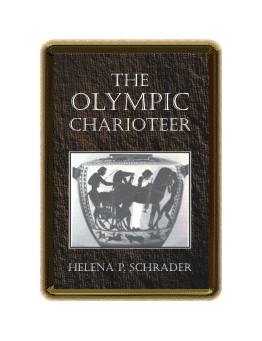
Two cities at war –
Two men with Olympic ambitions -
And one slave – the finest charioteer in Greece
Set in archaic Greece, and based on incidents recorded in Herodotus, this is the tale of a young man's journey from tragedy to triumph – and the story of the founding of the first nonaggression pact in recorded history: the Peloponnesian League.
Award-winning novelist Helena P. Schrader has again created a novel full of rich and realistic characters while providing readers a remarkable insight into archaic Spartan society. Well researched and intelligently interpolated from recorded facts, Schrader's Sparta is a refreshing change from the stereotypes encountered in much modern literature.
"…an extremely entertaining novel....Anyone interested in exploring the years prior to the Persian invasion – the alliances and intrigues, especially between Sparta and her future ally Tegea – will enjoy this novel." Jon Martin, author of The Headlong God of War and In Kithairon's Shadow.
"…this is another gem to polish and keep in my bookcase when I want a look back to Greece!" Millien.
A free teacher supplement is also available for teachers using this novel in their classes. Read excerpts from The Olympic Charioteer. View the book's video trailer.
The Olympic Charioteer can be ordered from bookstores or on line retailers such as amazon.com.
Order now!
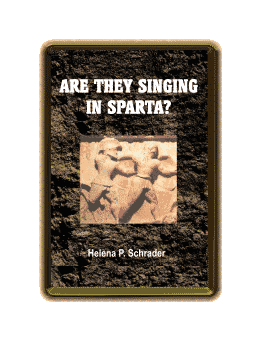
Messenia is in revolt, and the Messenians have been outwitting Sparta's crack troops. On the advice of Delphi, Sparta requests that Athens appoint a new supreme commander for Sparta's army. Athens, siding with Messenia, intentionally selects an obscure schoolmaster unlikely to help Sparta win the war, Tyrtaios. Tyrtaios was born lame, has no military experience, and everything he has ever heard about Sparta makes it the last place on earth where he wants to live.
Read excerpts from Are They Singing In Sparta?
The Spartan officer Agesandros is horrified by the "joke" Athens has played on Sparta by appointing Tyrtaios as Sparta's Supreme Polemarch. But as the son of a notorious brawler and drunk who gained Spartan citizenship only after a radical reform of the Spartan constitution, his voice counts for little. Furthermore, while Agesandros is excessively ambitious, his sister is married to a helot, and his nephew appears to have joined the rebellion against Sparta.
The widow Alethea, the daughter of a Spartan nobleman, was sent to Athens for safety during the "Time of Troubles" that led to the Great Reforms. She alone understands how Tyrtaios is suffering in Sparta. Yet when her growing sons fall foul of the authorities, she finds herself under increasing pressure to remarry, and Agesandros is the most obvious suitor.
This novel is set in the archaic period – 250 years before the Peloponnesian War that would warp Spartan society into a caricature of its former self. It focuses on explaining how Sparta's unique constitution evolved to make Sparta the first democracy in recorded history.
Are They Singing In Sparta? can be ordered from bookstores or on-line retailers such as amazon.com.
Order now!
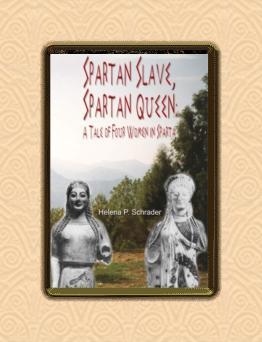
In ancient Sparta during the Second Messenian War, two women, one beautiful and one ugly, are captured and enslaved in the same raid. This is the story of how each responds to their new situation and the women they meet in Sparta.
Niobe's beauty is so great that it captures the attention of the Messenian leader, Aristomenes. He makes her a cherished concubine – until the Spartan "Scourge of Messenia," Agesandros, captures Aristomenes' palace. Niobe suddenly finds herself a slave, and the spoils of the Spartan prince Anaxilas.
Unlike the beautiful and coveted Niobe, Mika is so disfigured by warts that her own uncles sold her into slavery. She becomes the spoils not of a prince but of Agesandros' squire, Leon, a slave himself. He sends her back to serve his master's wife, Alethea, in Sparta.
While Niobe provokes the hostility of the Spartan Queen, Mika encounters the kindness of Alethea and her beautiful but spirited daughter, Kassia. Soon Anaxilas turns his affections from Niobe to Kassia, while Mika falls hopelessly in love with Leon, and Leon covets only the affection of Niobe.
This book picks up where Are They Singing in Sparta? left off. Although the novel revolves around unrequited love on all sides, it is really a reflection on what beauty is and how it affects human interactions – with a surprise ending. Read a review of Spartan Slave, Spartan Queen.
Spartan Slave, Spartan Queen can be ordered from bookstores or on line retailers such as amazon.com.
Order now!
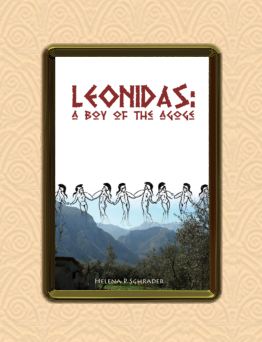
The smaller of twins, born long after two elder brothers, Leonidas is considered an afterthought from birth – even by his mother. Lucky not to be killed for being undersized, he is not raised as a prince like his eldest brother, Cleomenes, but instead has to endure the harsh upbringing of ordinary Spartan youth. Barefoot, always a little hungry, and subject to harsh discipline, Leonidas has to prove himself worthy of Spartan citizenship. Struggling to survive without disgrace, he never expects that one day he will be king or chosen to command of the combined Greek forces fighting a Persian invasion. But these are formative years that will one day make him the most famous Spartan of them all: the hero of Thermopylae.
This is the first book in a trilogy of biographical novels about Leonidas of Sparta. This first book describes his childhood in the infamous Spartan agoge. The second focuses on his years as an ordinary citizen, and the third describes his reign and death.
Leonidas Lives!
Book II of the Leonidas Trilogy
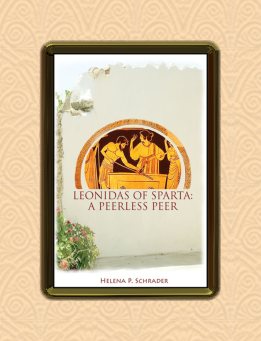
Sparta at the start of the 5th century BC is in crisis. The Argives are attacking Sparta’s vulnerable island of Kythera, but King Cleomenes is more interested in meddling in Athenian affairs. His co-monarch, King Demaratus, opposes Cleomenes' ambitions, and soon the kings are at each other’s throats. Exploiting this internal conflict, Corinth launches a challenge to Spartan control of the Peloponnesian League, while across the Aegean Sea the Greek cities of Ionia are in rebellion against Persia and pleading for Spartan aid.
King Cleomenes’ youngest half brother Leonidas has only just attained citizenship. He has no reason to expect that this revolt will shape his destiny. At 21, Leonidas is just an ordinary ranker in the Spartan army, less interested in high politics than in putting his private life in order. He needs to find reliable tenants to restore his ruined estate, and – most important – to find the right woman to be his bride.
Meanwhile, his niece Gorgo is growing up. Not particularly pretty, she is nevertheless precocious and courageous – qualities that get her into trouble more than once. This is the story of both Leonidas and Gorgo in the years before Leonidas becomes king of Sparta, and before the first Persian invasion of Greece sets Leonidas on the road to Thermopylae .

(Come and Take Them!)
Book III of the Leonidas Trilogy
Persia has crushed the Ionian revolt and is gathering a massive army to invade and punish mainland Greece, but in Sparta the dangers seem closer to home. The Eurypontid King Demaratus is accused of being a usurper, while the Agiad King Cleomenes is going dangerously mad. More and more Spartans turn to Leonidas, Cleomenes’ half brother and son-in-law, to provide leadership. But Leonidas is the younger of twins, and his brother Brotus has no intention of letting Leonidas lay claim to the Agiad throne without a fight.
This novel follows Leonidas and his wife Gorgo as they steer Sparta through the dangerous waters of domestic strife and external threat, working together as a team to make Sparta the best it can be. But the forces that will destroy not only Leonidas but his Sparta are already gathering – not just in Susa and Sardis, but in the hubris of a rising Athens and the bigotry and xenophobia of his fellow Spartans. The murder of two Persian ambassadors by an agitated Spartan Assembly sets in train the inevitable conflict between Sparta and Persia that will take Leonidas to Thermopylae – and into history.
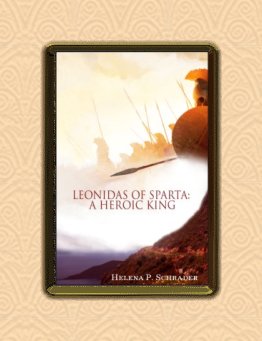
Leonidas: A Heroic King, published 2012.
Order Paperback Kindle Edition
Keep up to date on this trilogy by visiting:
Leonidas and Gorgo of Sparta





ONLINE TRANSLATOR AND DICTIONARY
PRIVACY I COPYRIGHT I CITING I SITE MAPThis site is best viewed with IE6 (or higher), a browser window sized at 1024 pixels wide or wider, and with a monitor display resolution set at 1280x1024.
Text varies on this site between British and American English spelling. Most research was done in Europe and compiled for British English publications. Interviews and reviews reflect both American and British English, as Helena Schrader is a leading authority on this subject in the US and Europe.
Contents of this website are copyrighted. ©1993-2012 Helena P. Schrader unless otherwise noted. If you would like to use the material of this site, please contact Helena Schrader. If you experience any problems with this site, please contact the web mistress.



Site design and maintenance Crystal Cloud Graphics
Web Hosting Elysium Gates.com
